AI Governance & Review Operating Model
sabbatical project — compliance checker built; operating model designed, not yet run with a team
Most teams adopt AI in documentation informally — someone starts using it, it spreads, and nobody can say what AI touched, what a human checked, or where the line sits. That breaks the day something ships wrong.
This page is the operating model I’d run when a team uses AI: what AI does, what always needs a human, and how I’d account for both.
View the compliance dashboard →
The Three-Layer Model
Each layer has a distinct job. Collapsing them — letting AI quietly absorb a team-owned or manager-owned responsibility — is where these models fail in practice.
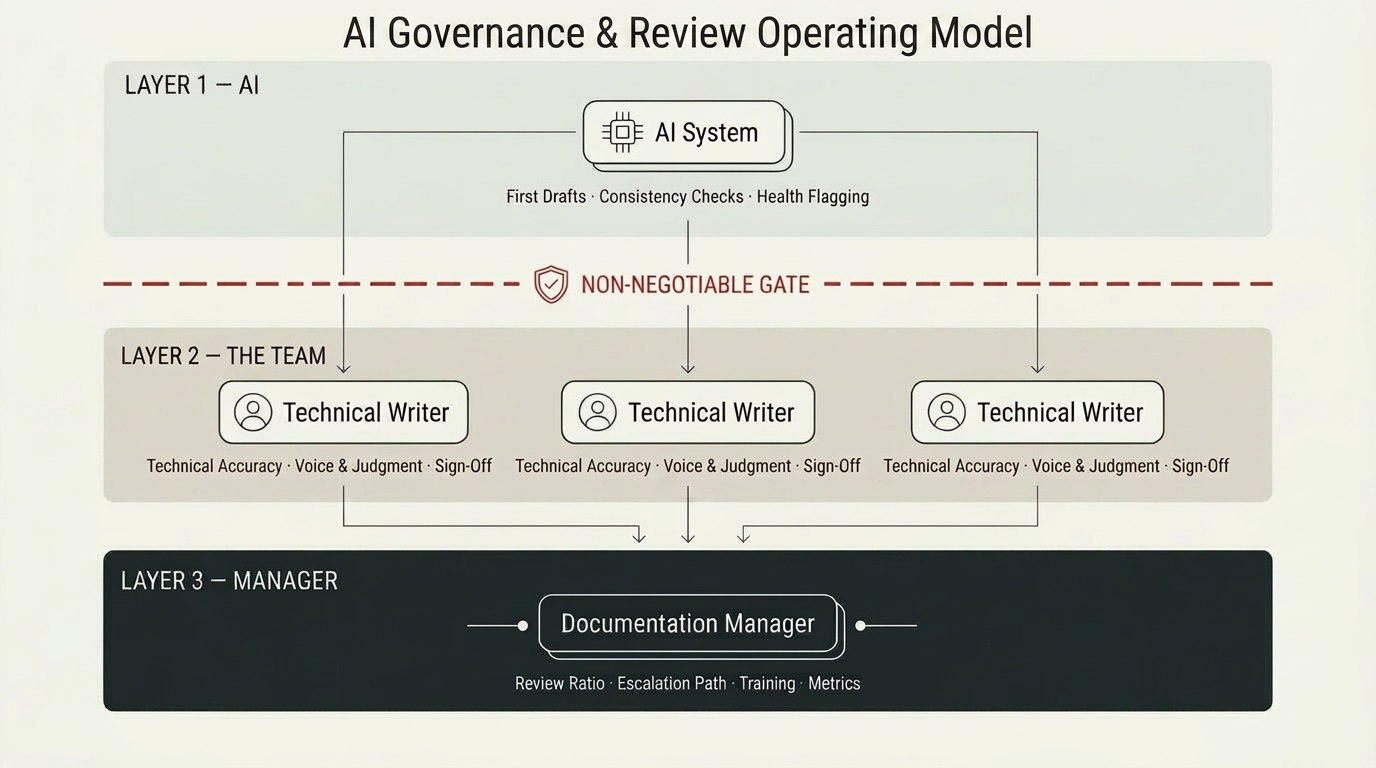
Layer 1 — What AI Owns
First drafts + consistency checks + health flagging- Generates first-draft content from specs, tickets, or PRDs
- Runs structural and language-quality checks against the style guide
- Flags stale, low-coverage, or inconsistent content
- Drafts release-note language from tickets AI does not get sign-off, customer-facing publication, or judgment calls on accuracy or appropriateness.
Layer 2 — What the Team Owns
AI draft → technical accuracy → voice & judgment → sign-offEvery writer is accountable for:
- Verifying technical accuracy against the actual product
- Making the judgment calls AI can’t — what to cut, what needs context
- Final sign-off, with their name on it If a writer can’t explain why AI-assisted content is correct, it doesn’t ship.
Layer 3 — What I’d Own as Manager
Review ratio + escalation path + training + metrics| Responsibility | In practice |
|---|---|
| Review ratio | How much AI output gets spot-checked vs. fully reviewed, adjusted as trust is earned |
| Escalation path | Who's told when AI gets it wrong, what gets corrected |
| Training | Every writer knows the workflow and its failure modes — not just early adopters |
| Traceability | A record of what AI touched, so any piece can be traced back |
| Metrics | Edit-cycle time, post-AI error rate, review bottlenecks — reported, not claimed |
Proof point
I ran Layer 1 and 2 in practice at Zeta — a two-stage AI editorial pass, language checks first, then structural validation, that writers used before sign-off. Edit cycles got 30–40% faster, and every piece still went through human review before publishing. Layer 3 at scale — a documented review ratio, a real escalation path, a standing metric — is what I’d build next in a team-management role.
Related
GenAI Process Innovation - the proven workflow this model is built from Documentation Health Operating Cycle - where this model’s monitoring layer connects