Documentation Infrastructure
Status: Designed during the sabbatical, not yet built — grounded in real docs-as-code migration work at Zeta
I led the team’s docs-as-code migration at Zeta - standardizing repository structure, branching conventions, and site deployment workflows within a live CI/CD pipeline where merges triggered automated builds. The infrastructure model below is what I’d formalize from that experience into a complete operating system for documentation infrastructure - the next step beyond what I’ve already run in production.
Documentation infrastructure defines how documentation is created, managed, reviewed, and delivered within an engineering organization.
It focuses on the operational systems that support documentation at scale, ensuring that content can be reliably produced, updated, and published as products evolve.
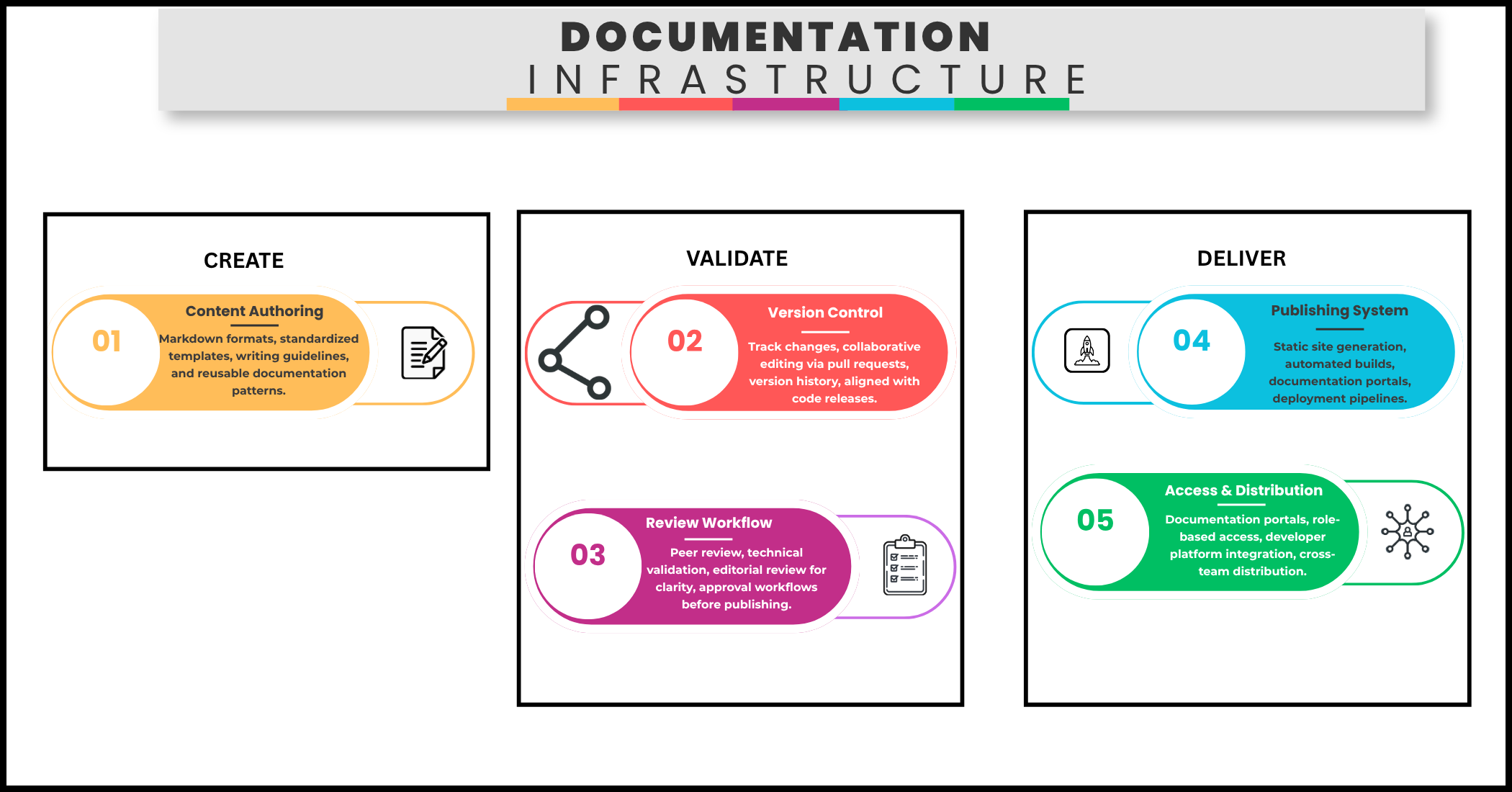
Figure: Documentation Infrastructure System — Authoring, Version Control, Review, Publishing, Distribution
Infrastructure Objective
The goal of this model is to establish a reliable and repeatable system for documentation operations. It would enable a team to:
- create documentation efficiently
- manage updates alongside product changes
- maintain quality through structured workflows
- publish documentation consistently
- support collaboration across teams This is the kind of system that keeps documentation usable and up to date in fast-moving environments.
Core Infrastructure Components
This model is built through a set of operational layers.
Content Authoring
Defines how documentation is created and maintained by contributors. This includes:
- Markdown or structured content formats
- standardized templates
- writing guidelines for contributors
- reusable documentation patterns The focus here is on enabling contributors to produce consistent content with minimal friction.
Version Control
Integrates documentation with engineering workflows - the layer I’ve already run in production at Zeta. Key capabilities include:
- tracking changes to documentation
- enabling collaborative editing through pull requests
- maintaining version history
- aligning documentation updates with code releases Version control ensures that documentation evolves in sync with the product.
Review Workflow
Introduces quality checks into the documentation process. This includes:
- peer review processes
- technical validation by engineers
- editorial review for clarity and consistency
- approval workflows before publishing Review workflows help maintain accuracy and reliability without slowing down delivery.
Publishing System
Handles how documentation is built and delivered to users. Examples include:
- static site generation
- automated documentation builds
- internal or external documentation portals
- deployment pipelines for documentation updates A strong publishing system ensures that documentation is always accessible and reflects the latest changes.
Access and Distribution
Focuses on how documentation reaches its users. This includes:
- documentation portals
- role-based access (internal vs external users)
- integration with developer platforms
- distribution across teams and environments The emphasis here is on ensuring that the right users can access the right information at the right time.
System View
This model operates as a delivery pipeline.
Authoring → Version Control → Review Workflow → Publishing → Distribution