End-to-End Product Documentation System
Status: Designed during the sabbatical - not yet built as a single running system
This is the operating model I’d run a documentation team against - connecting product changes to published content through one structured system.
60-Second Summary
Product documentation works best when it is treated as an operating system, not a collection of files.
1. System Overview
Documentation connects product changes to user understanding through a structured flow.
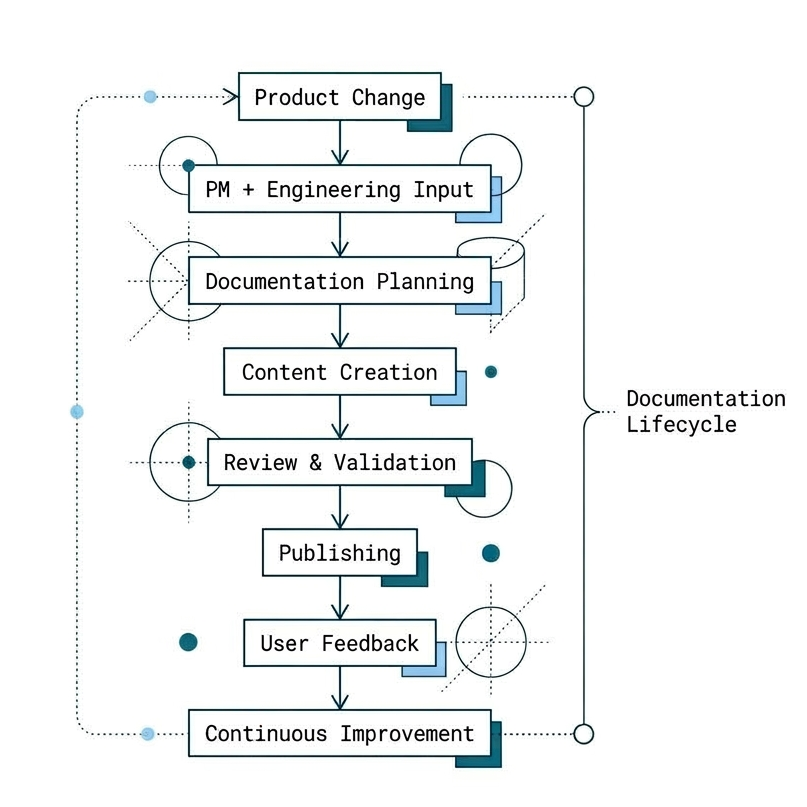
Figure: End-to-End Product Documentation System — product changes flow through planning, creation, and review into publishing and continuous improvement
2. Core Content Ecosystem
Each content type serves a different user but operates as one system.
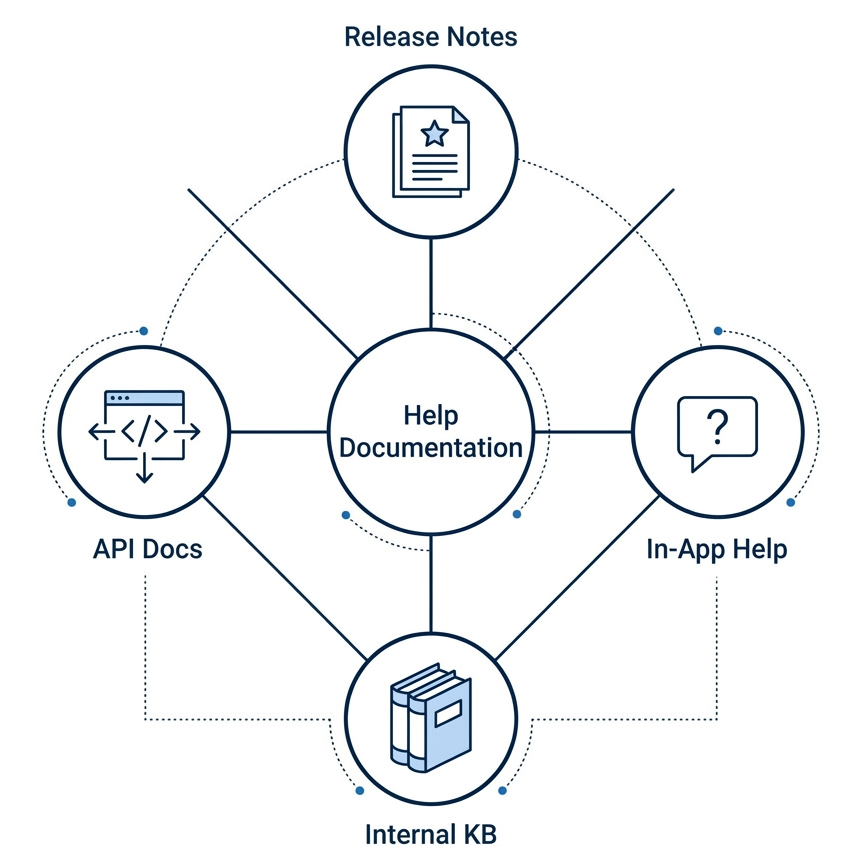
Figure: Core Content Ecosystem — each content type serves a different user but operates as one connected system
3. Operating Model
Documentation scales only when these principles are enforced.
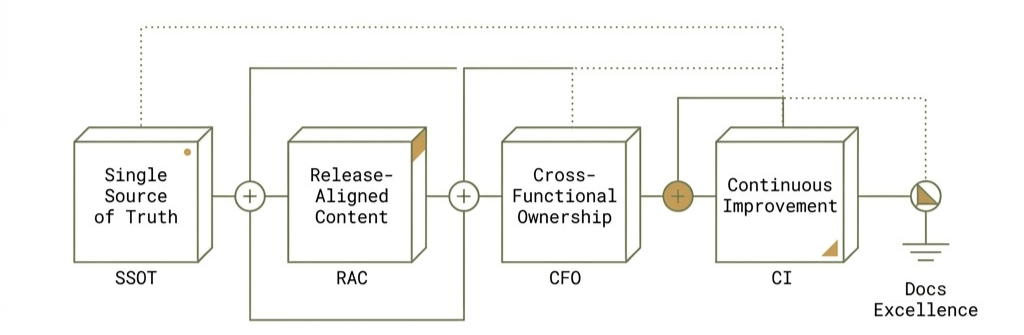
Figure: Documentation Operating Model — four principles that enable documentation to scale consistently across teams and releases
4. Documentation Workflow
INTAKE → PLAN → DRAFT → REVIEW → PUBLISH → FEEDBACK| Stage | Focus |
|---|---|
| Intake | Capture product changes |
| Plan | Identify impacted content |
| Draft | Create documentation |
| Review | Validate accuracy |
| Publish | Release content |
| Feedback | Improve continuously |
5. Governance Layer
Standards
   ↓
Templates
   ↓
Review Process
   ↓
Version Control
   ↓
Ownership
Governance ensures consistency across teams and releases.
6. AI-Assisted Documentation
Feature Input
     ↓
AI Draft Generation
     ↓
Human Review
     ↓
Standardized Output
     ↓
Multi-Channel Publishing
AI accelerates production but editorial ownership remains human. This stage of the model is the one piece I’ve actually built and run - see the End-to-End AI-Assisted Publication Pipeline.
7. Measurement System
User Search → Content Usage → Feedback → Improvements| Metric | Outcome |
|---|---|
| Search success | Findability |
| Ticket deflection | Reduced support load |
| Content freshness | Accuracy |
| Release readiness | Timeliness |
| API usability | Developer success |
8. System Impact
Better Docs → Faster Onboarding → Fewer Tickets → Higher AdoptionA strong documentation system directly impacts product success.
9. Applied Experience
This model reflects experience building documentation systems across:
- API documentation
- knowledge base platforms
- release documentation workflows
- governance frameworks
- AI-assisted content systems
It demonstrates how documentation can operate as a scalable product system.
Related
Knowledge Architecture Model - the information model this system is built on
Documentation Infrastructure - the authoring and delivery layer underneath this system