GenAI Process Innovation
This initiative explored how generative AI could support editorial workflows by reducing repetitive review tasks and improving documentation consistency at scale, led as a team-wide pilot under my ownership.
60-Second Summary
Context
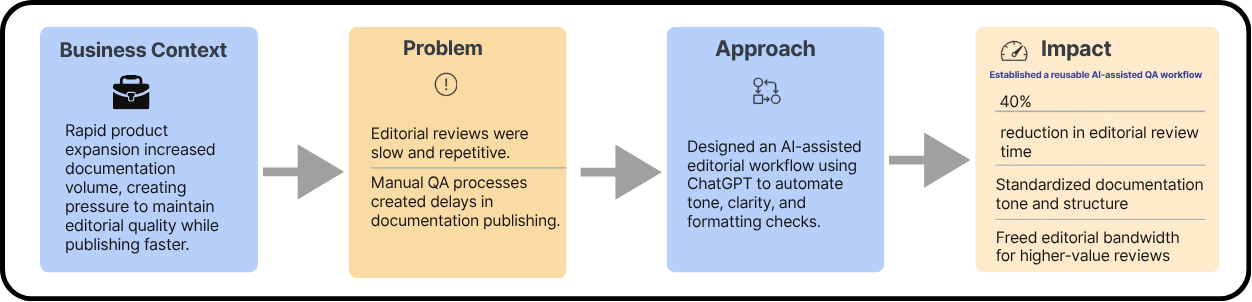
As Zeta’s product footprint expanded, the documentation team needed to support faster product releases without sacrificing editorial quality.
However:
- editorial reviews relied heavily on manual effort
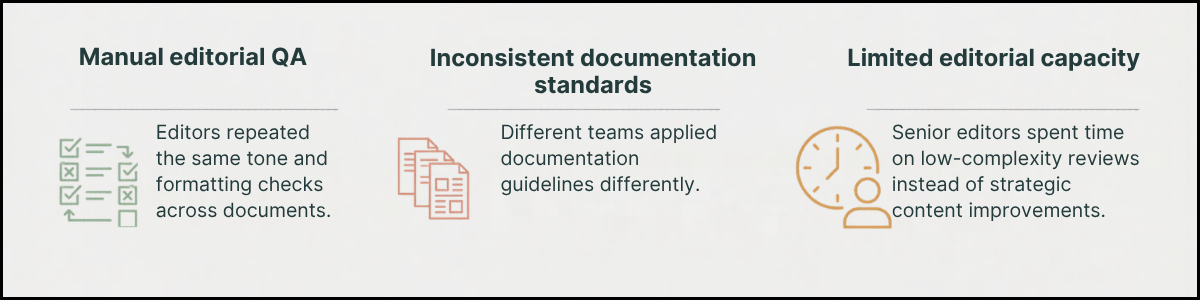
- documentation quality standards varied across writers
- senior editors spent significant time on repetitive editorial checks
These challenges slowed documentation publishing and created operational bottlenecks for the team.
Problem
Three structural issues limited editorial efficiency across the team.
Approach
I led the team’s shift to an AI-assisted editorial workflow, designing a documentation-specific prompt framework and driving its adoption across the team.
The goal was to give writers a fast, consistent self-review pass while keeping editorial accountability with me and the senior reviewers — not to remove human judgment from the process.
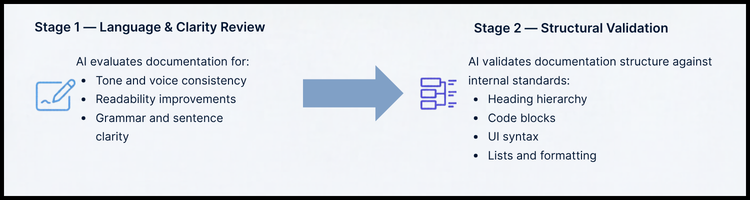
Two-Stage Editorial Framework
This framework separates language quality from structural validation, ensuring documentation is both clear to read and consistent with internal standards.
Workflow Transformation
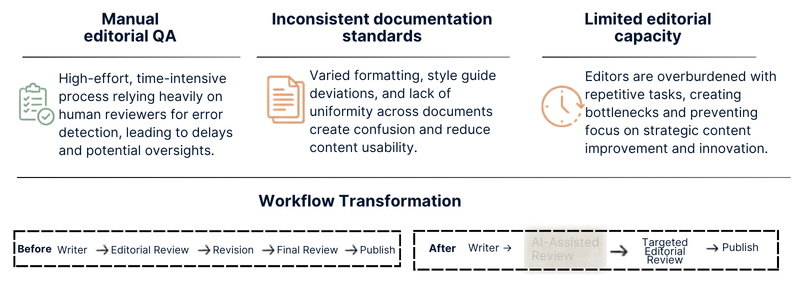
I redesigned the team’s editorial workflow around this framework: writers ran an AI-assisted self-review pass before formal review, reducing repetitive manual effort and freeing editors to focus on higher-value content decisions.
AI-assisted review reduced repetitive editorial tasks for the team and let editors focus on context-aware judgment calls instead of mechanical checks.
Impact
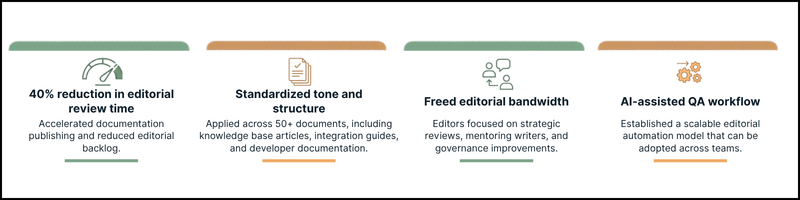
The pilot delivered measurable improvements in documentation operations under my ownership, including reduced editorial review effort and improved publishing efficiency.
Strategic Contribution
Beyond the workflow change itself, I introduced a structured approach to using AI responsibly in documentation operations:
- designed a documentation-specific GenAI prompt framework, tuned to our style and structural standards
- evaluated workflow bottlenecks and identified where AI assistance added the most value
- defined success metrics and validated the approach before wider rollout
- built onboarding material and trained the team for adoption
- retained editorial sign-off as a non-negotiable step, so AI accelerated drafts without bypassing review
Key Insight
AI proved highly effective for scaling consistency and low-complexity editorial checks, while human review remained essential for context-aware evaluation.
The model I’d take into any team I lead: AI scales consistency; editors keep judgment. AI handles repetitive, mechanical passes — the team’s editorial judgment stays the gate before anything publishes.
This pilot demonstrated how a documentation team can adopt AI responsibly — improving speed and consistency without trading away the judgment that makes documentation trustworthy.
Related
AI Governance & Review Operating Model - the operating model this pilot’s principles scaled into
AI-Driven Documentation Workflow - how this workflow extends beyond editorial review